The rainy season has started in earnest and although I welcome the rain for the sake of our garden, the lakes I sail on and farmers’ crops, I do wish for an occasional clear night because there are some special things happening in the December sky.
On 5 December, the Springbok Full Moon (the names I use are from South Africa, by the way!) will be the last of a series of three supermoons. It will be nearly as large as the exceptional November supermoon.
Most of the planets will be hard to see in December. Mercury will re-appear in the eastern sky before dawn early in the month. It will be at its highest on 10 December but still close to the horizon. Soon after that it will race behind the Sun, to re-appear in the evening sky in February. Venus is at the end of its long pre-dawn apparition and is very low in the east before dawn at the start of the month. At the start of December, you may catch a glimpse of Mars, very low in the west after sunset – by the middle of the month it will not be visible. In February next year it will be at opposition behind the Sun and a month or two later it will re-appear in the dawn sky. Jupiter rises at 9:32 pm at the start of the month and by New Year’s Eve it will rise at 7:22 pm. It will be near the Gemini Twins, but will be much brighter than them, at the end of an arc from Castor to Pollux to Jupiter. Extend a line from Pollux through Jupiter and you will find Procyon, the brightest (indeed the only bright) star in Canis Minor the Little Dog. Saturn is well up in the northern sky in the evening. It is quite bright and has a distinct yellow tinge. You will need a telescope to see its rings – a spotting scope at high magnification will show them. Currently we are close to the ring-plane and the rings look very narrow.
The Geminid meteor shower runs from 4 to 17 December., peaking before dawn on 14 December. In the Southern Hemisphere it is the finest meteor shower of the year, with the possibility to see more than 2 meteors a minute. The combined vectors of our orbit and that of the meteors means that if you extend the path of a meteor it will appear to point back to near Castor in Gemini. It is easy to watch a meteor shower – all you need is to lie under a dark sky and keep your eyes open. This year there is no moon interference but in December there is a high likelihood of being clouded out.
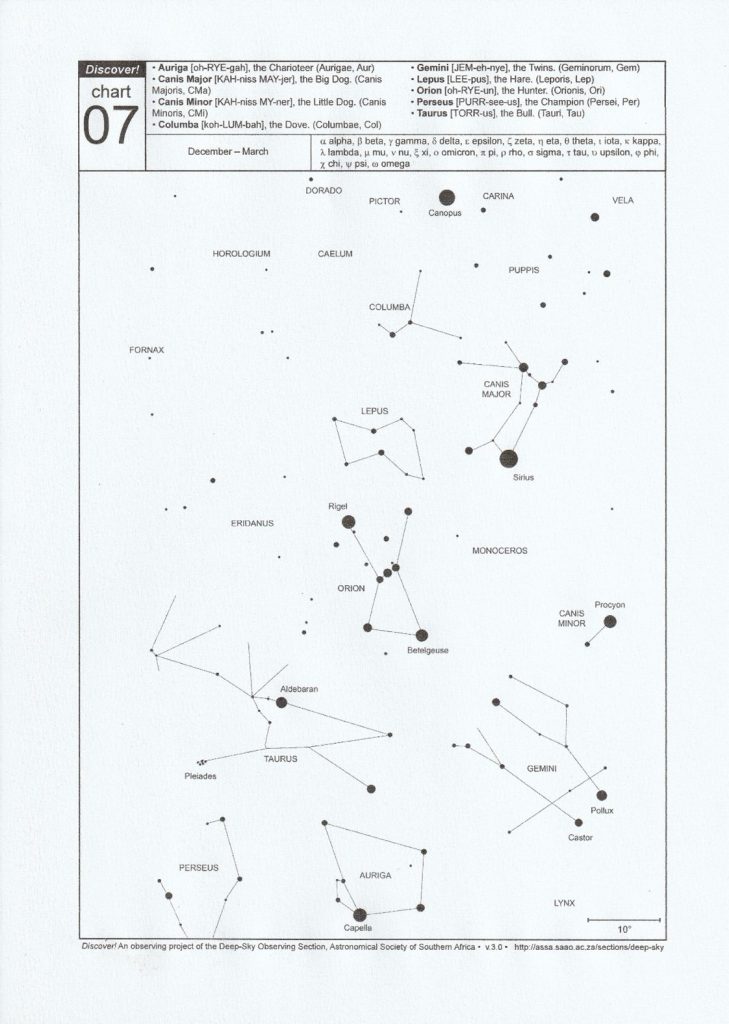
After sunset, look to the east to see constellation of Orion, the Giant. The three stars in a line that make up his belt rise due east so are a good direction indicator. To the left of the belt is the bright, red star Betelgeuse that marks his shoulder. To the right is the bright, blue star Rigel that marks his knee. Extend a line upwards through the belt stars to find an A-shape pattern of stars, the Hyades in Taurus. At the end of one leg of the A is another bright, red star – Aldebaran. Extend a line downwards through the belt stars to find Sirius in Canis Major – the brightest star in the night sky. The graphic below shows the stars I have mentioned. It comes from the Discover Charts prepared by the Astronomical Society of Southern Africa – a trove of good information can be found on their website at: https://assa.saao.ac.za/how-to-observe/deep-sky-objects/
Keep looking up!
Peter Morris, Astronomical Society of Harare
30 November 2025