

When November arrives in Zimbabwe, the first rains are never far away, and with them comes one of nature’s most spectacular displays of colour. The flamboyant tree announces the arrival of summer in a blaze of red and orange.
Mid-November in Zimbabwe is traditionally regarded as the beginning of our main rainy season. The air begins to change, the first storms gather on the horizon, and the countryside waits expectantly for the relief of rain after months of dry heat and dust. It is also the beginning of a relatively short but spectacular period when one of our most recognisable ornamental trees bursts into flower. Almost overnight, the flamboyant transforms itself into a magnificent display of colour, its brilliant red, orange and occasionally yellow flowers visible from a considerable distance.
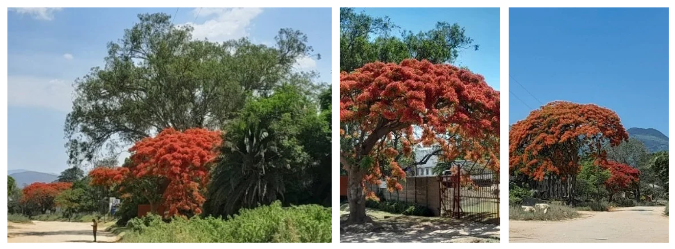
Scientifically known as *Delonix regia*, the flamboyant is also called the Flame Tree, Royal Poinciana, Peacock Flower and Flame of the Forest, among many other names. Its name is derived from the French word *flamboyer*, meaning to flame or blaze, and it is easy to understand why. When in full flower, the tree looks almost as though it has caught fire.
Belonging to the Fabaceae or bean family it came originally from the dry forests of northern and western Madagascar. Sadly, much of this habitat has been destroyed or fragmented through deforestation, agricultural expansion, charcoal production and uncontrolled burning. While the tree has not become extinct in the wild, its natural environment remains under considerable pressure.
One of its most valuable attributes is the generous shade it provides. Usually growing to around 10–15 metres, it develops an enormous, spreading, umbrella-shaped canopy which can be wider than the tree is tall. Its foliage is particularly attractive, with delicate, fern-like leaves made up of numerous tiny leaflets which give the tree an almost feathery appearance.
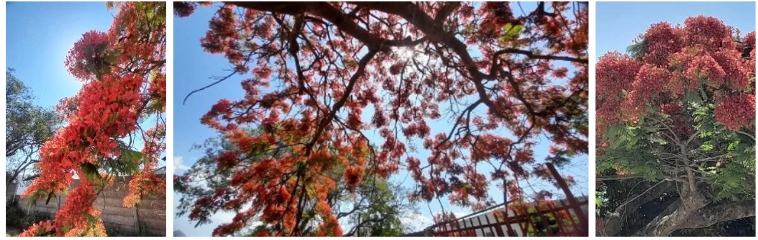
During the dry season, the flamboyant may shed most of its leaves, leaving its branches exposed. This makes its eventual flowering display even more dramatic, as the flowers often appear before the fresh foliage has fully developed.
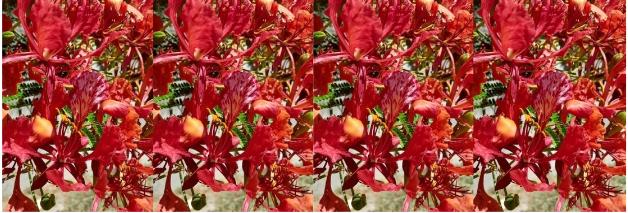
The flowers themselves are quite remarkable. Each has five petals, with four spreading outwards while the slightly larger fifth petal often carries distinctive markings in white, cream or yellow. Although the familiar flamboyant is generally scarlet or orange-red, yellow-flowered forms also exist. I have never personally seen a yellow flamboyant, although I understand there was once one growing in the grounds of Parirenyatwa Hospital in Harare, no longer there due to the expansion of the Hospital.
The flowering period can last several weeks, depending on the climate and growing conditions. The flowers attract a variety of pollinators, including bees and butterflies, while birds also visit them for their nectar. Despite its widespread popularity, the flamboyant is not a tree that should be planted without some consideration. It needs plenty of room to develop its magnificent canopy, and its extensive, shallow-spreading root system can cause problems if planted too close to buildings, walls, paving and underground drains. It also makes growing other plants beneath it rather difficult. Anyone who has ever listened to a builder or contractor discussing the beautiful tree growing a little too close to a house will probably understand this particular problem!
Some of the older flamboyants found in Zimbabwean towns are magnificent examples of just how much character a tree can develop over the years. Trees that have stood for fifty years or more often have wonderfully gnarled trunks and meandering branches which twist and fold around one another. Their smooth, greyish bark and intertwined limbs can almost resemble the folds of an old blanket. There is something rather enchanting about these mature trees. They have witnessed generations of families, changing neighbourhoods and the gradual development of the towns around them. Often planted decades ago, they have become part of the character and history of the properties they occupy.
Its long, woody seedpods are another distinctive feature. They can grow to more than half a metre in length and remain on the branches long after the flowers have disappeared. Once dried, the seeds can be used to make jewellery, particularly necklaces and bracelets. They are also incorporated into traditional crafts, and visitors to Great Zimbabwe may come across beautifully made seed jewellery among the wares offered by local craft vendors.
The pods and seeds have found other uses too, including in traditional musical instruments and children’s toys. In some communities, the flowers and seeds have also featured in traditional games. The tree has practical environmental value as well. Its extensive root system helps bind soil, while its broad canopy provides shade and helps moderate temperatures beneath it. Its flowers provide food for pollinators, and its foliage contributes to the environmental benefits associated with urban trees. Its wood has traditionally been used for fuel and some simple household purposes, although it is not particularly valued as a structural timber because the branches can be brittle.
Isn’t it interesting that the flamboyant tree, originally confined to Madagascar, has become such a familiar and much-loved feature of landscapes thousands of kilometres away, now being found throughout much of Africa, the Caribbean, Asia and the Americas? Here in Zimbabwe, it has become part of our summer landscape. It is often found in gardens, along roadsides and in older residential areas, usually planted deliberately by someone who appreciated the beauty and shade it would eventually provide.
There is something rather lovely about that. Unlike the indigenous trees that grow naturally in our bushveld and forests, many of our flamboyants are the result of someone having planted a seedling years ago, perhaps never imagining just how magnificent it would become.
And so, as November arrives and the first summer rains approach, we can look forward to those familiar splashes of colour appearing across our towns and gardens. For a few short weeks, the flamboyant takes centre stage, reminding us that summer has arrived and that nature has its own rather spectacular way of celebrating.
The main flowering period is September to November, with October usually the spectacular peak in Harare.
Jacarandas are partly deciduous, meaning they shed some or much of their foliage. Depending on the conditions, they can produce their flowers while the branches are still relatively bare. This creates that extraordinary effect of purple blossoms almost completely covering the tree. It is one reason the flowering season feels so dramatic: the colour appears to arrive almost overnight.
There is also a scientific dimension. Research has indicated that jacarandas have been flowering earlier over the past century. Changing temperatures are one possible
Benefits we all appreciate in these very hot months:
- They provide shade and help cool streets and gardens.
- Their canopies can intercept some dust and airborne particles.
- Their flowers provide resources for visiting insects.
- Their beauty makes urban spaces more inviting and encourages people to value trees.
However, they are not indigenous to Zimbabwe. The species has become naturalised in parts of the country and can spread beyond where it was planted and can be described as sometimes invasive. I think there is room to appreciate the beauty of our jacarandas while also making a conscious effort to plant and protect indigenous trees.
There is a reason jacaranda season holds such a special place in the hearts of so many Zimbabweans. It marks a transition. We have come through the drying months of winter and then endured the intense, building heat of the months that follow. The purple carpets of fallen flowers seem to signal that the long wait for rain may soon be over. Gardens begin to change, the landscape prepares to come alive again, and we find ourselves looking towards the promise of a new growing season. And yet, the jacaranda is also a reminder that our landscapes are shaped by history, migration and human decisions. A South American tree arrived in southern Africa almost two centuries ago and became part of how generations of Zimbabweans experience spring.
Perhaps that is the beauty of trees: they offer us shade, colour and memories, while quietly telling stories of where we have come from and how the places we call home have changed.