
New Moon is on 10 October, and the Whale Full Moon is on 26 October.
Mercury becomes an evening object in the western sky, at its highest on 15 October. Venus is close to the end of its evening apparition, a brilliant object in the west after sunset for the first half of the month. It is getting lower each day and will disappear in the Sun’s glow to re-appear at the Morning Star in November. Saturn reaches opposition on 4 October, when it will rise at sunset and set at sunrise. It will be at its closest to Earth and at its brightest. A small telescope will reveal it rings. Mars rises before 2 am and Jupiter rises soon after.
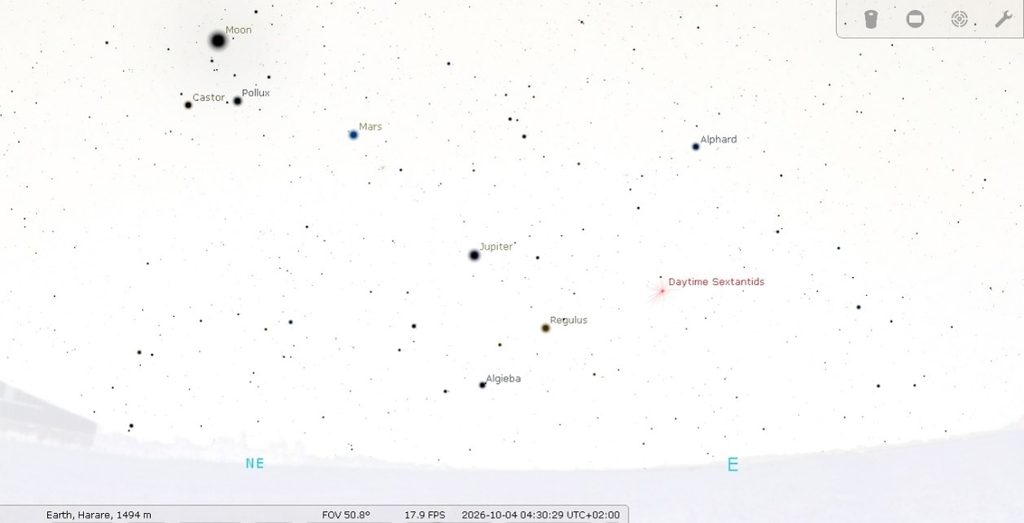
There are some interesting meetings in the sky this month. Before dawn on the morning of 4 October, the Moon, Pollux (one of the twins in Gemini), Mars, Jupiter and Regulus (the brightest star in Leo) will be lined up.
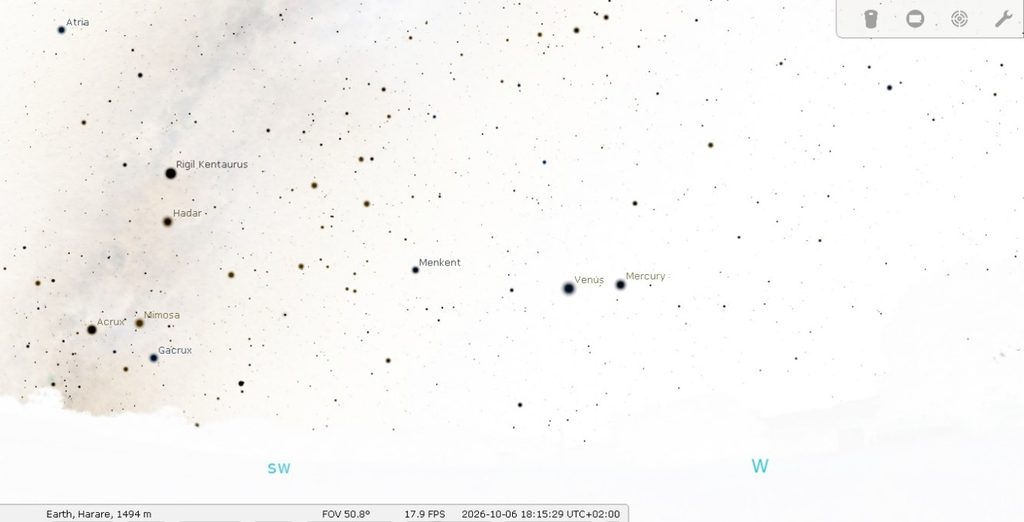
On 7 October, Venus and Mercury will be very close. Look for Venus low in the West just after sunset and use binoculars to find Mercury to its right.
On 12 October, the two-day-old young Moon will be between Venus and Mercury in the west after sunset. Venus may be too low to see unless you have clear, low horizon to the west. If you do see it, likely you will not see it again until November as the Morning Star.
On 21 October, between midnight and 4 am, you may be able to see the Orionid meteor shower. If you see a meteor and its path appears to originate in Orion, then it is an Orionid. The prediction is for 20 meteors per hour. The Orionids are notable because they derive from debris left behind by Comet Halley.
The Astronomical Society of Harare will hold its next meeting on Saturday 10 October at 2:30 for 3:00 pm in the gazebo at Mukuvisi Woodland. There will be tea followed by presentations on astronomical topics. The presentations are intended for people with no astronomical knowledge, and all are welcome. Mukuvisi charges a $2 entry fee.
Keep looking up!
Peter Morris, Astronomical Society of Harare