

There is something rather wonderful about jacaranda trees, isn’t there? Every October, they transform our streets and gardens into a haze of purple and lilac. In Zimbabwe, they have become so much a part of spring that it is easy to forget they are not originally African trees.
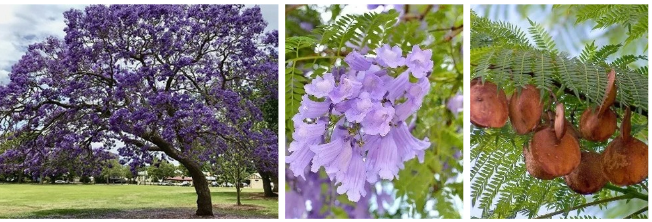
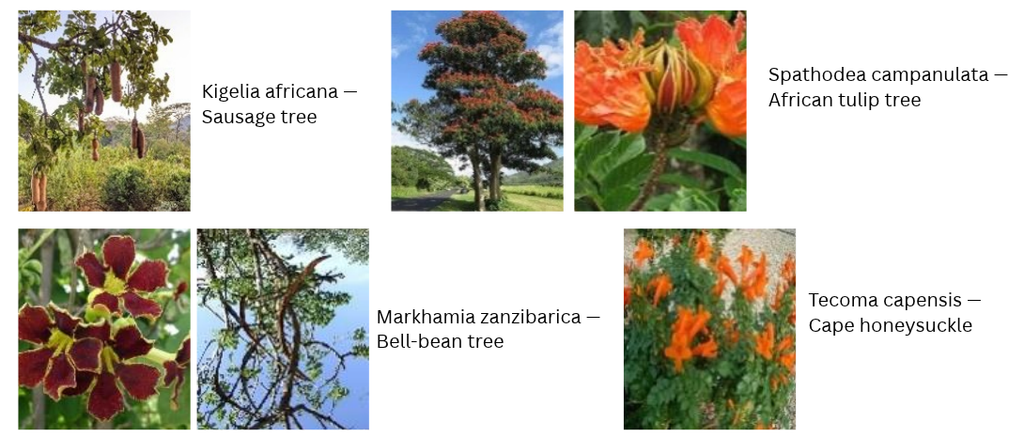
The tree we know in Zimbabwe is the Jacaranda mimosifolia, commonly called the blue jacaranda, although its flowers are more accurately described as violet, lavender or lilac. Its original home is South America, particularly Bolivia, north-western Argentina and neighbouring regions. It is of the plant family Bignoniaceae, the same family as several other beautiful trumpet-flowered trees and climbing plants:-
Jacaranda trees produce flat, round, woody seed pods containing papery, winged seeds that can be carried by the wind. The pods appear towards the end of the school year, and many a teacher has filled those final weeks with art classes, turning them into Christmas decorations, painted and glittered up for the festive season. A simple seed pod, a little imagination and a generous helping of glitter!
The jacaranda was introduced to southern Africa in the early 19th century. Botanical history records the introduction of jacarandas to the Cape by the horticulturist Carl von Ludwig, who was involved in establishing Cape Town’s early botanical garden. From the Cape, jacarandas spread to other towns and cities across southern Africa. They flourished in suitable warm climates, particularly in higher-altitude areas with sunny conditions and seasonal rainfall. Pretoria eventually became so famous for its jacarandas that it earned the nickname Jacaranda City. But Zimbabwe developed its own equally lovely association with the trees.
The story takes us back to the very early days of Salisbury, as Harare was then known. According to the Tree Society of Zimbabwe, the first jacaranda is believed to have been planted in Salisbury in late 1899 or early 1900. Six seedlings were reportedly brought from the botanical gardens in Durban by a honeymooning couple. One was planted in a garden on what was then Cape Avenue, later Montague Avenue and now Josiah Chinamano Avenue. Jacarandas were subsequently planted along the avenue, helping establish the tree-lined streets that became a feature of the city. By 1908, the first tree was reportedly observed flowering. Around 1913, naturalist Charles Frederick Swynnerton established a stand of jacarandas near Chirinda Forest in the Eastern Highlands.
The original Harare tree survived for nearly a century before collapsing in 1998. The avenues and gardens that followed, however, continue to carry its legacy.
There is something rather special about the thought that a tree brought across borders as a small seedling became part of Zimbabwe’s seasonal identity.
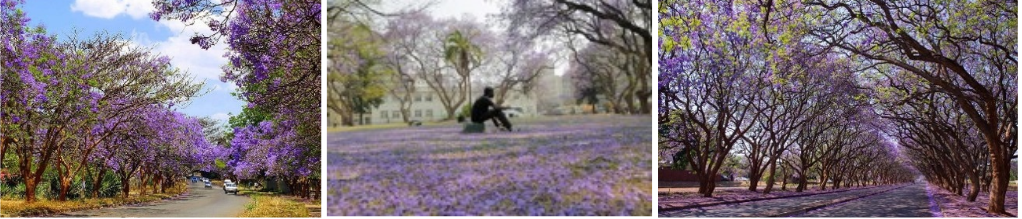
The main flowering period is September to November, with October usually the spectacular peak in Harare.
Jacarandas are partly deciduous, meaning they shed some or much of their foliage. Depending on the conditions, they can produce their flowers while the branches are still relatively bare. This creates that extraordinary effect of purple blossoms almost completely covering the tree. It is one reason the flowering season feels so dramatic: the colour appears to arrive almost overnight.
There is also a scientific dimension. Research has indicated that jacarandas have been flowering earlier over the past century. Changing temperatures are one possible
Benefits we all appreciate in these very hot months:
- They provide shade and help cool streets and gardens.
- Their canopies can intercept some dust and airborne particles.
- Their flowers provide resources for visiting insects.
- Their beauty makes urban spaces more inviting and encourages people to value trees.
However, they are not indigenous to Zimbabwe. The species has become naturalised in parts of the country and can spread beyond where it was planted and can be described as sometimes invasive. I think there is room to appreciate the beauty of our jacarandas while also making a conscious effort to plant and protect indigenous trees.
There is a reason jacaranda season holds such a special place in the hearts of so many Zimbabweans. It marks a transition. We have come through the drying months of winter and then endured the intense, building heat of the months that follow. The purple carpets of fallen flowers seem to signal that the long wait for rain may soon be over. Gardens begin to change, the landscape prepares to come alive again, and we find ourselves looking towards the promise of a new growing season. And yet, the jacaranda is also a reminder that our landscapes are shaped by history, migration and human decisions. A South American tree arrived in southern Africa almost two centuries ago and became part of how generations of Zimbabweans experience spring.
Perhaps that is the beauty of trees: they offer us shade, colour and memories, while quietly telling stories of where we have come from and how the places we call home have changed.