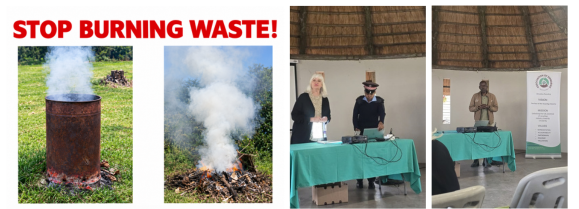

On the first Tuesday of every month, Sharon Hook of Glean & Green Zimbabwe hosts the Waste Management Network Meeting. This month’s session focused heavily on a critical and often overlooked issue: the open burning of waste. The meeting featured a series of presentations, starting with the local fire brigade, followed by deep dives into the environmental and health impacts of burning trash, and concluding with a strategic look at the situation in Zimbabwe.
The session kicked off with a presentation from the fire brigade as they underscored the immediate physical dangers associated with uncontrolled fires, setting the stage for a deeper discussion on why burning waste is a practice that needs urgent addressing.
Following the fire brigade, the presentation shifted to the scientific and global scale of the issue, asking the question: “How widespread is the problem?” According to data from the CCAC (Climate and Clean Air Coalition), roughly 2 billion tonnes of municipal waste are produced globally each year, and shockingly, about 40% of this is openly burnt. This burning happens everywhere, from households and streets to dumpsites and landfills. Because the waste stream is so heterogeneous, the resulting pollution is complex and dangerous. The presentation detailed exactly what is released when waste burns, highlighting a toxic cocktail of pollutants such as black carbon and carbon monoxide.
The meeting brought the global problem down to a local level. Using data from the 2022 Zimbabwe Census, some startling statistics were highlighted; for example, 33.4% of all Zimbabwean households reported burning waste, in rural areas, this figure jumps to 43.0% and in urban areas, it is 14.2%.
One of the key takeaways for all attendees to acknowledge is that vulnerable populations are disproportionately affected by open waste burning. Children, pregnant women, waste workers, and nearby households deserve particular protection from the toxic exposure that results from this practice. EMA has made it clear that it will be taking enforcement action to protect communities from the dangers of uncontrolled waste burning. This includes monitoring, compliance checks, and working with local authorities to ensure that waste management practices meet environmental and health standards. Click here to read more from EMA.